

Outdoor wall coverings: aesthetics and functionality
The facade of a building is its calling card: it protects, isolates and communicates its identity. For this reason, the outdoor wall coverings They're not just an aesthetic choice, but also a fundamental technical decision to ensure durability, weather protection, and living comfort. In this article, we'll guide you through the main solutions, functional advantages, and most common applications, so you can make an informed choice about the best covering for your needs.
What is an outdoor wall covering?
A outdoor wall covering It is a finish applied to the external surface of walls, facades or building structures, with the aim of:
- Protect support from atmospheric agents (rain, frost, UV radiation)
- Isolate thermally and acoustically
- Improve aesthetics of the building
- To heal damaged or deteriorating media
The choice of material and application technique depends on multiple factors: exposure, climate zone, type of building, condition of the substrate, design requirements.
The main types of external cladding
1. Acrylic coatings
Acrylic coatings are among the most widely used due to their versatility and ease of application. They offer good weather resistance, adapt to a wide range of substrates, and guarantee long-lasting durability. They offer a wide range of colors and finishes, making them ideal for aesthetic applications.
Pros: ease of installation, wide choice of colours, water resistance.
Against: less breathability than other solutions.
2. Siloxane coatings
Made with siloxane resins, these coatings combine high breathability e hydrophobicity, that is, the ability to repel rainwater. They are particularly suitable for humid environments, exposed facades, or buildings in urban and industrial areas, subject to smog and dirt.
Pros: self-cleaning effect, high durability, color stability.
Against: slightly higher cost, requires well-prepared supports.
3. Silicate coatings
Composed of mineral binders, such as potassium silicate, they are highly breathable and chemically bond with the mineral substrate. They are ideal for historic buildings, renovations, and surfaces subject to rising damp.
Pros: high breathability, compatibility with ancient supports.
Against: more complex application, limited color choice.
4. Elastomeric coatings
Thanks to their formulation, elastomeric coatings can adapt to the movements of the substrate, covering microcracks and cracks. They are ideal for buildings subject to intense thermal cycles or vibrations, such as prefabricated structures or facades exposed to significant temperature fluctuations.
Pros: elasticity, waterproofness, structural protection.
Against: low breathability, need for stable supports.
Technical aspects to consider
The selection of outdoor wall coverings must take into account several technical elements that directly influence its effectiveness over time:
1. Support Compatibility
Each coating has a different chemical and physical composition, which makes it more or less compatible with certain types of plaster or masonry. A silicate coating, for example, adheres perfectly only to mineral substrates. Otherwise, it risks premature detachment or poor aesthetics.
2. Breathability
An essential parameter, especially in buildings subject to rising damp or condensation. Breathability allows internal water vapor to escape through the walls, preventing deterioration of the substrate or the formation of mold.
3. Water repellency and weather resistance
Rain, snow, salt spray, and UV rays are the main enemies of outdoor surfaces. A good coating must repel water while still allowing for breathability, be resistant to UV rays, and maintain its color over time.
4. Elasticity and ability to cover microcracks
In environments subject to structural movements, temperature changes or settlement, an elastomeric coating can prevent the formation of visible cracks, extending the life of the treated surface.
5. Desired aesthetic appearance
The aesthetic result depends not only on the chosen color, but also on the grain size, the surface finish (smooth, scratched, or spatula-brushed), and the composition of the coating itself. Each choice has technical and maintenance implications.
Common applications and contexts of use
The outdoor wall coverings They find application in numerous construction sectors, both residential and industrial, or public. Here are the most common examples:
1. Single-family and two-family residential buildings
In these situations, facade protection is often also tied to aesthetic requirements. Siloxane and acrylic coatings are widely used due to their aging resistance and wide color range.
2. Condominiums and large housing complexes
Here, the durability of the coating and its ability to withstand urban pollution, freeze-thaw cycles, and wear are key. Siloxane and silicate solutions offer a good compromise between resistance and breathability, while elastomeric versions are preferred where cracks or fissures are present.
3. Restoration of historic buildings
Mineral or silicate coatings are the most suitable, thanks to their compatibility with the original materials and their ability to breathe. In these contexts, the goal is to preserve the architectural identity and protect the structures without altering their historical properties.
4. Industrial and commercial environments
Where high mechanical and chemical resistance is required, reinforced coatings are often chosen, with components resistant to aggressive substances or intense washing and maintenance cycles.
5. Marine or high humidity areas
Near the sea or in humid mountain environments, coatings must offer high performance against salt spray and condensation. The self-cleaning effect of siloxane coatings is particularly beneficial in these conditions.
The importance of correct application
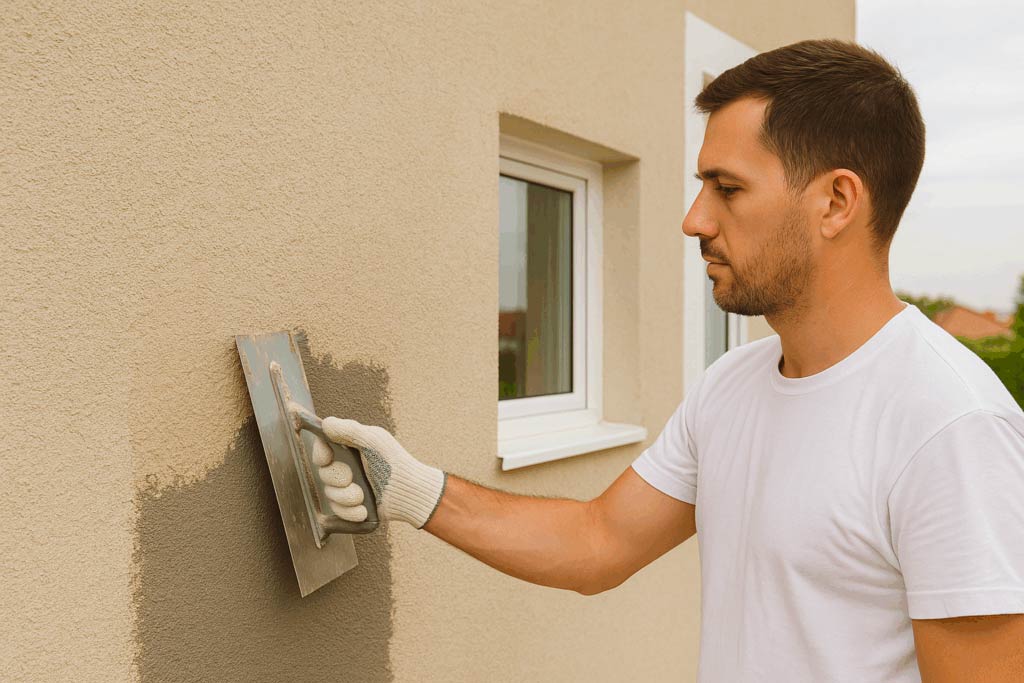
Even the best coating It loses its effectiveness if not applied according to correct professional practices. A well-executed installation is the result of attention, experience, and respect for timing and environmental conditions. Here are the key points to consider:
1. Preparation of the substrate
The substrate must be clean, dry, and free of loose particles and biological contaminants (mold, algae). It is often necessary to apply a specific primer to promote the coating's adhesion and even out the substrate's absorption.
2. Control of climate conditions
Excessively low or high temperatures, wind, or high humidity can compromise the yield and drying of the product. The procedure must be performed in favorable weather conditions, generally between 5°C and 35°C.
3. Application method and tools
Spatula, roller, brush, or spray: each method has its advantages, but it must be consistent with the type of product used. The uniformity of the layer and the thickness must comply with the manufacturer's instructions.
4. Drying and post-application protection
The coating must be allowed to dry and harden within the specified timeframe. During this time, it is essential to protect it from rain, dust, and pollutants that could alter its finish.
A professional installation, entrusted to expert and experienced personnel, is the necessary condition to ensure durability, technical performance and optimal aesthetic result.
Conclusions
The outdoor wall coverings They play an essential role in the protection, enhancement, and conservation of buildings. Choosing the right product can't be based solely on color or price, but must consider:
- the type of support,
- the environmental conditions,
- the technical characteristics of the material,
- and the quality of the application.
Rely on expert professionals like Gigaterm It allows you to obtain a long-lasting, aesthetically pleasing result that is in line with design requirements.
Frequently Asked Questions
What is the best exterior wall covering for humid environments?
Siloxane coatings are ideal for humid environments thanks to their high breathability and water resistance.
How often should exterior wall coverings be renewed?
It depends on the type of product and exposure, but on average every 8-15 years.
Is it possible to apply a new covering over an existing one?
Yes, but only if the old layer is stable, clean and compatible with the new material.

Gigaterm is a leading company in the development, production, and installation of water-based nanotechnology coatings, designed to offer innovative, sustainable, and high-performance solutions.
 English
  Italian