

A practical guide to terrace waterproofing
Terraces are environments exposed to the elements: rain, snow, frost and dirt can compromise their functionality and aesthetics. A system of waterproofing terraces A well-designed terrace not only prevents water infiltration, but also protects the underlying structure and preserves the property's value. In this guide, you'll learn practical methodologies, technical assessments, and operational choices to effectively and lastingly protect your terrace.
Preliminary evaluation and ideal conditions
Analysis of the current state
Before intervening, it is crucial to carefully analyze the existing terrace:
- Check the slopes to ensure water drainage.
- Check the condition of the joints and gaps between tiles or screed.
- Identification of cracks, microcracks or surface damage.
- Check the adhesion of the previous layers (if already existing).
- Measurement of the residual humidity of the substrate (must be compatible with the chosen waterproofing material).
Ideal environmental conditions
For best results, the application should meet some environmental conditions:
- Temperatures between 5°C and 35°C (depending on the product).
- No rain expected in the next few hours.
- Dry or very low humidity substrate.
- Avoid application under direct sunlight during the hottest hours of the day.
These precautions minimize the risk of defects such as bubbles, detachments or reduced yield.
Systems and technologies for waterproofing terraces
Dry systems (membranes/bituminous sheathing)
- Reinforced sheets, modified bitumen and composite materials are used.
- They require welding or gluing.
- Higher thickness, but high mechanical resistance.
Liquid or semi-fluid systems
- Liquid sheaths based on polyurethane, polyurea or mixed resins.
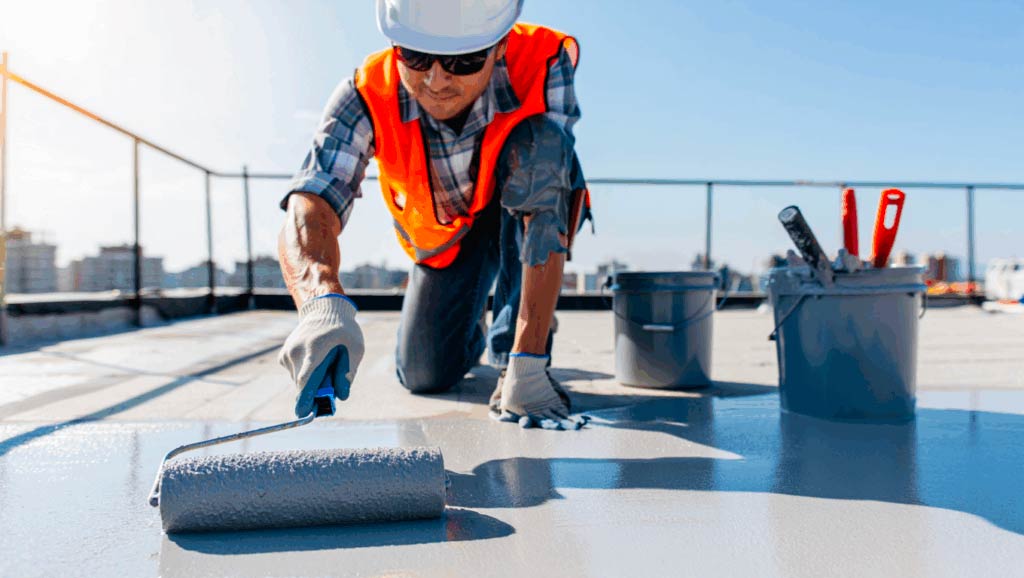
- Can be applied by roller, brush or spray.
- Continuous layer, without joints.
- They can be inserted inside a new waterproof package or over existing flooring, if compatible.
Nanotechnological and penetrating water-repellent systems
- Formulations that penetrate deep into the pores, modifying the surface structure of the material.
- They do not form surface plastic films, maintaining the breathability of the substrate.
- Excellent as an additional protective system or for preventative maintenance.
Operational phases for the’waterproofing
- Cleaning and preparation of the substrate
- Remove dirt, dust and mortar residue.
- Degrease and decontaminate.
- Repair cracks, holes or unevenness with suitable material.
- Applying primer or bonding
- It serves to increase the adhesion of the waterproof system.
- Application of the waterproof system
- First uniform coat, with selected material.
- Insertion of reinforcement mesh in critical areas (joints, corners).
- Second final coat to close the layer.
- Protection and finishing
- Protect the sheath until the flooring is installed.
- Laying the flooring over the waterproof layer (if applicable).
- Final inspection and testing
- Check for holes, gaps or uncovered areas.
- Test with water to check for leaks.
Comparison of systems
| System | Continuity of the coating | Ease of application | Mechanical resistance | Maintenance |
| Bituminous membranes | Media (junctions) | Average | High | Average |
| Liquid sheath (polyurethane, etc.) | High (seamless) | High | Good | Low |
| Penetrating nanotechnologies | Not a full movie, but protective effect | High | It depends on the underlying material | Very low |
Advanced strategies for specific problems
Restoration on existing flooring
If the terrace is already tiled, some compatible liquid membranes allow you to work over the existing covering—provided it's stable and intact. For deep joints, pre-filling or surface smoothing is recommended.
Anti-mold and capillary rising damp treatment
Nanotechnological water-repellent products reduce rising damp and prevent mold growth. Regular preventative applications can maintain the protective effect.
Management of thermal expansions
On terraces subject to strong climatic variations, it is advisable to provide movement joints and expansion points, reinforced with flexible materials that absorb stress.
Costs: How to Estimate Your Budget
The costs for the’waterproofing terraces vary based on:
- size of the terrace;
- difficulty of access;
- chosen system (liquid, membranes, nanotechnologies);
- media conditions (if any repairs are needed).
Indicatively, A complete professional liquid system can cost between €25 and €60/m², depending on the level of finish and the techniques required. A membrane installation can be slightly more expensive and require additional work.
That said, it's crucial to consider the long-term cost: a well-built system drastically reduces maintenance and repair costs compared to poorly executed, low-cost interventions.
Conclusions
This A practical guide to terrace waterproofing He explained how to assess the condition of the terrace, choose the most suitable system, correctly execute the operational steps, and estimate the actual costs. The goal is to offer a practical and reliable overview for those who want to protect their terrace from water infiltration, mold, and structural deterioration.
A well-executed renovation is an investment that improves livability, ensures peace of mind, and preserves the property's value.
Frequently Asked Questions
Is it always necessary to remove the existing flooring?
No: there are liquid sheaths that can be applied to stable coatings, but integrity and adhesion must be assessed.
Can I do it myself?
Not recommended for extensive or structural interventions: application must be precise and professional to ensure effectiveness.
Gigaterm is a leading company in the development, production and installation of water-based nanotechnology coatings, designed to offer innovative, sustainable and high-performance solutions.
 English
  Italian